
- “Covimectin 12 mg” already exists in your wishlist
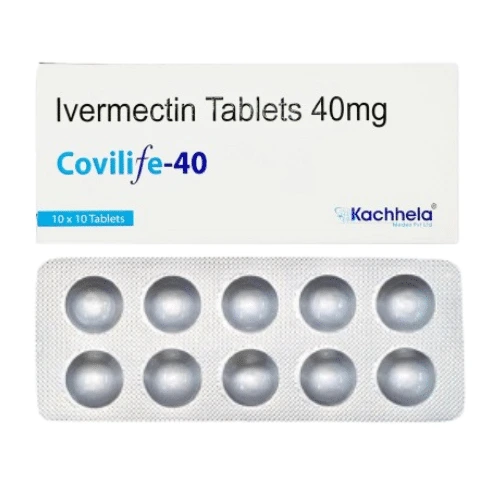
Ivermectin 40 Mg
Price range: $300.00 through $730.00
| Active Ingredient (Generic Name) | Ivermectin |
|---|---|
| Indication | Parasitic infections, Anti-Worm |
| Manufacturer | Kachhela Medex Pvt. Ltd. |
| Packaging | 10 tablets in 1 strip |
| Strength | 40mg |
| Delivery Time | 7 to 15 days |
Ivermectin 40 mg — Uses, Dosage, Side Effects, and What You Need to Know?
What is Ivermectin 40 mg?
Ivermectin is one of the most significant antiparasitic medicines discovered in modern medicine. It was first introduced in the late 1970s and has since transformed the treatment and control of several serious parasitic diseases worldwide. Its impact has been so profound that the scientists behind its discovery were awarded the Nobel Prize in Physiology or Medicine in 2015.
Ivermectin 40 mg is a higher-strength formulation of this medicine, typically prescribed for adults requiring a larger weight-based dose for specific parasitic infections. It belongs to the avermectin class of antiparasitic drugs and works against a broad range of parasites — both internal worms and external parasites such as mites and lice.
It is listed on the World Health Organization’s List of Essential Medicines and has been used in hundreds of millions of people globally through mass drug administration programmes targeting diseases like river blindness and lymphatic filariasis.
How Does Ivermectin 40 Mg Work?
Ivermectin works by targeting the parasite’s nervous system and muscle function in a highly selective way.
It binds to glutamate-gated chloride ion channels, which are found in the nerve and muscle cells of invertebrates like worms and insects but are absent in mammals. When Ivermectin binds to these channels, it causes them to open permanently, flooding the parasite’s cells with chloride ions. This leads to paralysis and death of the parasite.
Because these specific channels do not exist in human cells, Ivermectin is highly selective in its action — targeting parasites effectively while leaving human cells largely unaffected. This selective toxicity is one of the reasons Ivermectin has such a favourable safety profile in humans when used at recommended doses.
What Does Ivermectin 40 mg Treat?
Ivermectin 40 Mg is effective against a wide range of parasitic infections — both those that live inside the body and those that affect the skin and outer surface.
Strongyloidiasis Caused by Strongyloides stercoralis — a roundworm that uniquely can complete its entire life cycle within the human body, leading to persistent, self-perpetuating infections that can last for decades if untreated. In immunocompromised individuals, this can develop into hyperinfection syndrome — a life-threatening condition. Ivermectin is the first-line treatment for strongyloidiasis.
Onchocerciasis (River Blindness) is caused by Onchocerca volvulus, transmitted through blackfly bites near fast-flowing rivers. The infection can cause severe skin disease and progressive blindness. Ivermectin is the cornerstone of global programmes to eliminate river blindness.
Lymphatic Filariasis (Elephantiasis) A mosquito-borne parasitic disease caused by filarial worms that damage the lymphatic system, causing severe swelling of the limbs and genitals. Ivermectin is used as part of mass drug administration programmes alongside Albendazole to control and eliminate this disease.
Scabies A highly contagious skin infestation caused by the mite Sarcoptes scabiei. It causes intense itching and a characteristic rash. Oral Ivermectin is particularly useful for crusted (Norwegian) scabies — a severe form of the condition — and in institutional outbreaks where treating large numbers of people simultaneously is necessary.
Head Lice (Pediculosis capitis) Oral Ivermectin is used in cases where topical treatments have failed or are impractical. It is effective in eliminating head lice infestations.
Intestinal Roundworm Infections Ivermectin has activity against certain intestinal roundworms, including Ascaris lumbricoides and Enterobius vermicularis (threadworm), though other medicines are more commonly used as first-line treatment for these common infections.
Loiasis (Loa loa infection) is caused by the African eye worm, transmitted through deer fly bites in Central and West Africa. Careful medical supervision is essential when treating Loiasis with Ivermectin due to the risk of serious neurological reactions in patients with high microfilarial loads.
Ivermectin 40 mg Dosage Guide:-
Ivermectin 40 Mg dosing is strictly weight-based. The 40 mg tablet is designed for adults whose weight-based calculation requires this higher dose.
The standard dose across most indications is:
150–200 micrograms (mcg) per kg of body weight
| Body Weight | Approximate Dose |
|---|---|
| Up to 35 kg | 6 mg |
| 36–50 kg | 9 mg |
| 51–65 kg | 12 mg |
| 66–79 kg | 15 mg |
| 80–100 kg | 18 mg |
| Above 100 kg | As directed by the doctor |
For Strongyloidiasis:
- 200 mcg per kg as a single dose
- A repeat dose after 2 weeks is commonly recommended to ensure complete clearance
- In immunocompromised patients, longer treatment courses may be required
For Onchocerciasis:
- 150 mcg per kg as a single dose
- Repeated every 6 to 12 months as the infection is not fully cured with one dose — treatment controls the disease by suppressing microfilariae
For Scabies:
- 200 mcg per kg as a single dose
- A second dose after 1–2 weeks is recommended, particularly for crusted scabies
How to take Ivermectin 40 mg:
- Take on an empty stomach with a full glass of water
- Do not take with food — food significantly increases drug absorption and can raise blood levels unpredictably, increasing the risk of side effects
- Take at least 1 hour before or 2 hours after a meal
- Swallow tablets whole — do not crush or chew
- Do not take alcohol on the day of treatment
Who Can Take Ivermectin 40 mg?
Suitable for:
- Adults requiring weight-based doses of 40 mg
- Patients diagnosed with the conditions listed above are under medical supervision
Consult your doctor before use if:
- You are pregnant — Ivermectin 40 Mg is generally not recommended during pregnancy, particularly in the first trimester. Use only when clearly necessary and under direct medical supervision
- You are breastfeeding — small amounts pass into breast milk; consult your doctor before use
- You have liver disease — Ivermectin 40 Mg is metabolised in the liver; use with caution and monitoring
- You are elderly — you may be more sensitive to effects; medical supervision is advised
- You live in or have travelled to areas where Loa loa is endemic — high microfilarial loads of Loa loa can cause serious neurological reactions following Ivermectin treatment; testing may be required before treatment
Do not take Ivermectin 40 mg if:
- You have a known allergy to Ivermectin or any component of the tablet
- Children under 15 kg body weight — safety in very young or very small children is not well established
- You have meningitis or conditions affecting the blood-brain barrier — these may allow Ivermectin to enter the brain more readily, increasing neurological risk
Side Effects of Ivermectin 40 mg:-
Ivermectin 40 Mg is generally well-tolerated at recommended doses. Many side effects that do occur are related to the body’s immune response to dying parasites — known as a Mazzotti reaction — rather than the drug itself. These tend to be more pronounced in heavier infections.
Common and usually mild:
- Headache
- Dizziness
- Nausea
- Diarrhoea
- Abdominal pain
- Fatigue or weakness
- Muscle or joint pain
- Fever — often an immune response to dying parasites
- Skin rash or itching
Less common:
- Swelling of the face, limbs, or lymph nodes — particularly in onchocerciasis treatment as microfilariae die
- Low blood pressure (hypotension)
- Rapid heartbeat
- Visual disturbances — temporary and usually mild
Rare but serious — seek immediate medical attention:
- Severe neurological reactions — confusion, loss of coordination, seizures, encephalopathy. These are rare at standard doses but have been reported, particularly in patients with very high microfilarial burdens or Loa loa co-infection
- Severe allergic reaction — swelling of the face or throat, difficulty breathing, collapse
- Severe skin reactions — blistering or peeling skin
- Significantly low blood pressure — dizziness on standing, fainting
Drug Interactions:-
- Warfarin and anticoagulants — Ivermectin may enhance anticoagulant effects; INR monitoring is recommended
- Barbiturates, benzodiazepines, and other CNS depressants — may enhance the central nervous system effects of Ivermectin; use with caution
- Albendazole — sometimes used in combination for lymphatic filariasis in mass treatment programmes; generally well tolerated together under medical supervision
- Alcohol — avoid on the day of treatment; enhances CNS depressant effects and worsens dizziness
Important Precautions:-
Take on an empty stomach. Unlike many antiparasitic medicines that are better absorbed with food, Ivermectin should be taken on an empty stomach. Food — particularly a high-fat meal — significantly increases absorption and can raise blood levels to potentially unsafe concentrations.
Do not drive on treatment day. Dizziness and drowsiness are possible side effects, particularly in the first few hours after taking the dose. Avoid driving or operating heavy machinery on the day of treatment.
Loa loa co-infection. If you live in or have recently returned from Central or West Africa, inform your doctor before taking Ivermectin. Patients with high levels of Loa loa microfilariae in the blood can experience serious — occasionally fatal — neurological reactions following Ivermectin treatment. Your doctor may arrange blood testing before prescribing.
Follow-up is important for conditions like strongyloidiasis and onchocerciasis; follow-up stool tests or skin assessments confirm that treatment has been effective. Attend all scheduled follow-up appointments.
Frequently Asked Questions?
Is Ivermectin 40 mg suitable for self-treatment?
No. Given the weight-based dosing requirements, the range of serious conditions it treats, and the potential for significant side effects in certain patient groups, Ivermectin 40 mg should only be taken under the supervision of a qualified doctor with a valid prescription. Self-medicating is strongly discouraged.
Can Ivermectin 40 Mg be used for common threadworm or roundworm?
Ivermectin 40 Mg does have activity against these common infections, but medicines like Mebendazole, Albendazole, and Pyrantel are typically preferred as first-line treatments due to their established dosing and safety profiles for routine intestinal worm infections.
How long does Ivermectin 40 Mg take to work?
Ivermectin 40 Mg acts quickly — within hours of absorption, it begins paralyzing parasites. For skin conditions like scabies, improvement is usually noticeable within a few days. For systemic infections like strongyloidiasis, full clearance is confirmed by follow-up testing after 2 to 4 weeks.
Does Ivermectin 40 Mg cure onchocerciasis completely?
No. A single dose of Ivermectin kills the microfilariae (larval stage) but does not kill the adult worms, which can live for up to 15 years. Repeated dosing every 6 to 12 months is required to control the infection and prevent progression to blindness.
What about Ivermectin and COVID-19?
During the COVID-19 pandemic, there was significant public debate about using Ivermectin as a treatment or preventive measure. Major health authorities, including the WHO, FDA, and EMA, reviewed the available evidence and concluded that the data did not support the use of Ivermectin for COVID-19 outside of clinical trials. It is not approved or recommended for this purpose.
Storage Instructions:-
- Store below 30°C in a cool, dry place
- Keep away from direct sunlight and moisture
- Store in the original packaging until use
- Keep out of reach of children
- Do not use after the expiry date on the packaging
Final Thoughts:-
Ivermectin is genuinely one of the great medicines of modern times — it has changed and saved millions of lives through its role in controlling river blindness and lymphatic filariasis in some of the world’s most affected communities. At the individual patient level, it is a powerful and reliable treatment for serious parasitic infections like strongyloidiasis and scabies.
The 40 mg formulation is a higher-dose option designed for adults who require a larger weight-based dose. Used correctly, under proper medical supervision, with the right diagnosis and appropriate monitoring, it is a safe and highly effective medicine.
Always follow your doctor’s instructions precisely — take it on an empty stomach, avoid driving on treatment day, attend follow-up appointments, and speak up immediately if you experience any unusual symptoms during or after treatment.
Disclaimer:-
This content is for general informational purposes only and does not constitute medical advice. Always consult a qualified healthcare professional before starting any medication.
Additional information
| mg | 40 Mg |
|---|---|
| unit | 100 Tablets, 200 Tablets, 300 Tablets |

Reviews
There are no reviews yet.